Choosing a fruit tree
Luscious fruit from your backyard! Enjoy Nature's bounty! Incredible tree produces four kinds of fruit!
Live longer! Highest antioxidant fruit!
Selling the virtues of back yard fruit production is nothing new. "Step outside and pick an orange right off your own tree!" Citrus Heights, Orange County, Orangevale--these California place names reflect the sales techniques of early housing developers beckoning snow-bound easterners to California. A customer who moved here from Syracuse, New York, to retire had only two landscape requirements: an orange tree, and a palm tree. Such is the lure of California.
California's development history is intertwined with fruit trees. Since the Spanish padres brought seeds of the Spanish sweet orange (a seeded juice orange with thin skin, similar to our modern Valencia) and a thick-skinned lemon-like fruit, the earliest settlements by Europeans have taken advantage of the ideal fruit-growing regions of the state. The first citrus farm was planted in 1841 in Los Angeles, and William Wolfskill's oranges were selling in San Francisco during the Gold Rush for a dollar apiece.
Northern California growers quickly discovered that our climate was ideal for commercial production of stone fruits (apricots, cherries, plums, peaches and nectarines), and that these could be shipped back east for high profits because of the early harvest season here. All of these are readily grown as backyard trees. Apples are generally grown where autumn nights are cooler, and pears thrive in the Delta. In recent years Mediterranean and Asian fruits have become increasingly popular, and for good reason: persimmons, figs, and pomegranates are probably the easiest, lowest-maintenance backyard fruit trees.
So how do you choose a fruit tree? It's a very individual decision. The desirability of some fruits may outweigh the maintenance issues of the trees. Here's a checklist of considerations.
What do you have room for?
This is less important than you might think, based on newer spacing and training techniques.
Many methods have been promoted over the years to enable home gardeners to get fruit production in small yards. Miniature trees, multiple grafts, dwarfing rootstocks, close spacing, espaliered trees, and summer pruning all enable you to get more trees in your yard, and more fruit per square foot. Of these techniques, the close spacing and summer pruning are the easiest ways to get high yield from outstanding varieties.
Ignore old-fashioned spacing and pruning recommendations designed for orchard production. Your goals are smaller trees, better quality fruit, and a longer harvest season, and YOU are in control of the size and production of the trees. You can plant trees very close together, prune each one severely to reduce the size of the tree and the quantity of the fruit, and choose varieties that ripen over a long period. With the right combination of stone fruits, Mediterranean fruits, and citrus, you could get fruit from your backyard every month of the year!
What do you like? What would you actually use?
A fully-grown tree trained in the traditional 'orchard' style can produce hundreds of fruit! Soft-fruited types don't store well, and that is a LOT of fruit to eat or process in a few days.or pick up off the ground. It can be a considerable mess. Reducing total fruit production may be a major goal of pruning peaches, nectarines, plums, pluots, and (to a lesser degree) apricots and figs. These are all ripe for only a few days. So training them as small trees or shrubs, and pruning severely, enables you to plant several varieties and extend your harvest. On the other hand, cherries are so popular with birds that you don't have to worry about the fruit being a mess.
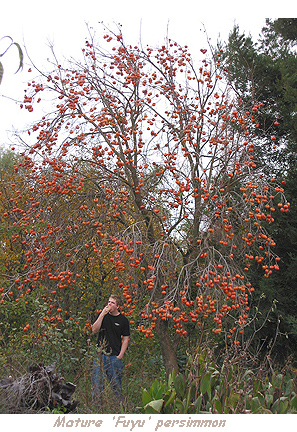 With more unusual fruits -- Asian pears, Fuyu persimmons, blood oranges -- you might want to try some from the farmer's market first. Though these keep much better than stone fruits, you may find your family just doesn't use that many--and by 'that many' I mean dozens or even hundreds.
What ripening period is important to you?
My own experience is that earlier-producing varieties of any particular fruit get heavier use in our household. The peach that ripens in June is prized; by late July you've eaten a lot of peaches. Early varieties are also less damaged by extreme heat. But the 'all-purpose' varieties tend to be mid- to late-season, and may have higher sugar content. Consider firmer textured varieties for mid and late season, as they will be more useful for pies, freezing, and canning. Or buy a good fruit dryer--nearly all fruit can be dried, including some that would surprise you (dried Asian pear slices are like candy).
Consider a mix of 'styles' and fruit types so you have something different each period during the season. An excellent combination, if you have room, is
- a self-fruitful cherry (May),
- an apricot and an early peach (June),
- a mid-season white nectarine (July),
- a late-season pluot (with a pollenizer) and/or a late peach (August),
- an Asian pear (September),
- a pomegranate (October),
- and a persimmon.
That would give fruit from late May through November! Citrus trees would round out the year, fruiting through the winter.
How patient are you?
If you're planting a fruit tree for your kids, you might want some fruit before they leave home! Peaches, nectarines, and plums all fruit on year-old wood, so you will actually get some fruit in the second growing season (thin off most of it so the tree can put its energy into growth). Spur-fruiting types such as apples, pears, apricots, and cherries take 3 - 4 years to produce fruiting wood.
What is easy to grow?
This includes how much pruning or spraying will be needed, which have special pest or disease considerations, and which fruit blemishes or damages easily (making them more vulnerable to extreme weather and pests).
Apples and pears, for example, are really kind of a hassle here. The fruit is sure to get codling moth, the 'worm' in your apple, and managing that pest requires a combination of trapping, spraying, and picking up the spoiled fruit on the ground. (For more information, see our 'Pest Notes' at www.redwoodbarn.com).
Larger-fruited stone fruits are considered the most desirable fruits. The flavor of a summer peach just off the tree is incomparable! But these must be pruned heavily or the branches will collapse from the weight of the fruit. This especially includes peaches, nectarines, plums, and pluots. It's important to keep a dense canopy so that the fruit isn't damaged in 100+ degree weather. Peaches and nectarines also require spraying to prevent peach leaf curl. These winter chores aren't very difficult, but must be done each year, and summer pruning techniques can be used to manage the tree size.
Persimmons, pomegranates, figs, and citrus, on the other hand, require no pruning or spraying at all. They can be pruned for size control, but it isn't necessary.
Which trees look nice in the landscape?
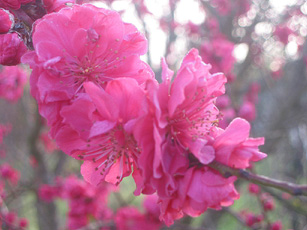 This can be an important consideration, as your fruit trees can be part of your landscape. Some have very showy flowers: 'Red Baron' and 'Fantastic Elberta' peaches, 'Garden Prince' almond (also a naturally small tree), and others. Cherries are a mass of white blossoms in early spring, with a narrow upright habit suitable to side yards or corners.
Some have all-season beauty: persimmons have vivid chartreuse new growth in spring, attractive shiny leaves in summer, golden fall color, and the winter fruit is showy even if you don't eat it (don't worry, the birds will!). Apricots and pie cherries have graceful spreading growth habits. And citrus trees have fragrant spring flowers, nice evergreen foliage, and colorful fruit all winter.
You really can 'enjoy nature's bounty!' and 'have luscious fruit from your back yard!' A little planning can just make it easier and more satisfying.
© 2008 Don Shor, Redwood Barn Nursery, Inc., 1607 Fifth Street, Davis, Ca 95616
www.redwoodbarn.com
Feel free to copy and distribute this article with attribution to this author.
Click here for Don's other Davis Enterprise articles
