Citrus
the little known varieties
From the Davis Enterprise, April 27, 2006
28 days of rain since March 1. 7 weeks straight where the high temperature was below average. Finicky bees balking at the cold and wet, sitting home and refusing to pollinate. Commercial growers and home orchardists are facing low to zero crop production on peaches, nectarines, plums, apricots. Peach leaf curl is at 100% infection rate on the leaves of peaches and nectarines. Brown rot has blighted the blossoms of many stone fruit trees, and is spreading down the branches.
Gardeners are getting grumpy.
Weeds are waist (shoulder?) high, and the grass has gone unmown for several
weeks. May is now ' Declare Your Lawn a Meadow ' month. Long faces at garden
centers, hardware stores. Landscapers, gardeners, and contractors have been
stymied.
I walk through my family
orchard, looking glumly at my dozens of stone fruit trees with their miserably
distorted leaves and blighted flowers. All our winter pruning efforts for
naught this year. On the way back to the house I pass my 12' tall kumquat,
branches laden with shiny fruit, and I can almost hear the tree asking, So,
what's all the fuss about? What about me, huh? I planted it primarily as an
ornamental, but there are hundreds of fruit, the blossoms are just peeking out,
and I do absolutely nothing special in the way of maintenance.
The fragrant flowers of
Citrus come in April, usually missing the rain. Few pest problems, fruit that
hangs on the tree for weeks, and attractive foliage make citrus especially
useful for the home gardener. Most grow tall enough to provide privacy, slowly
enough that they don't need pruning, and their fruit ripens in the gloomy
winter months.
First the basics.
Citrus likes a warm, sunny location. Frost protection may be necessary
on young trees. A couple of varieties (Mexican lime, Etrog citron) are tender
and will need protection even when they are older. A south or east facing wall
will be ideal. They benefit from a regular fertilizing schedule (3 – 4
x/year minimum), including some trace elements. And most people water their
citrus too often: deep, infrequent soakings are best. Containers work well, and
a large pot can hold a dwarf citrus for years.
The best time to plant Citrus
trees is when it is warm and the soil is workable, The young trees sulk if
their roots can't grow and spread quickly. So wait until the soil isn't soggy,
and the nights are warmer than 50F. Anytime from April through October is fine.
Note: the cold and gloom have slowed growth of the young trees, and demand
always exceeds supply early in the season. Be patient, and don't worry: the
young trees can be planted just fine during the summer months.
Everybody knows the navel
oranges, lemons, limes, and grapefruits. Meyer lemon (actually a sour orange),
Eureka or Lisbon lemon (your ' Sunkist ' type), and Navel oranges are the
best-selling varieties. Valencia oranges can extend your harves season into the
early summer; blood oranges have unique rich red flesh and juice, and mandarins
are holiday favorites.
But what about the other citrus?
There are dozens of citrus
varieties, including some real oddballs, and virtually all of them can be grown
here. So this is in praise of some of the ' lesser ' citrus.
Robert Fortune(1812 – 1880) is one of my life heroes. A gruff
Scotsman, he was appointed as an official plant collector in China by the
London Horticultural Society. He shaved his head and learned Mandarin, passing
in disguise through the previously closed country and sending thousands of
plants back to England over the course of four extended explorations. If you
see the species name ' fortunei ' it is one of the 120 or so important garden
plants he discovered: Euonymus fortunei, Trachycarpus fortunei, and so on.
In one case the genus itself
was named after him. Most citrus are in the genus Citrus (easy to remember,
eh?). But kumquats are cousins, in the genus Fortunella. They are the hardiest,
and arguably the most ornamental, citrus. Kumquat fruit hangs on the tree
year-around, so last year's fruit is still available as this year's is
ripening.
The skin is sweet and the
pulp is lemon-tart. So the way to experience a kumquat is to pop it in your
mouth whole and chew it all up rapidly. The sweet/tart combination is
unbeatable. It makes an outstanding marmalade if you have the patience to seed
the tiny fruit.
Mandarins and hybrids
The ' Owari Satsuma ' mandarin
is the very popular sweet, seedless, easy-to-peel holiday fruit. Satsumas are
slow-growing enough to be kept as a shrub, and among the most cold-hardy
citrus. Hybridization of a mandarin with a grapefruit yielded the ' Minneola '
Tangelo. The glowing orange fruit with the distinctive bump on the stem end
ripens in late winter into early spring, hanging on the tree for two months or
more until you're ready to enjoy it. Always a family favorite. Attractive
foliage on a compact tree—this one is ornamental enough to fill a focal
point in the garden.
Early breeding programs aimed
to get varieties with greater cold tolerance. The Mexican (Key) lime is tender
here, but a cross with the kumquat led to the Eustis limequat, a
heavy-producing hardy lime-like fruit with edible rind. A cross between the
kumquat and the mandarin led to the Indio Mandarinquat. Looks like a giant
kumquat, with similar tangy-sweet flesh and edible rind. A very decorative
tree. Note: Bearss is a true lime variety that is hardy here.
Grapefruits and hybrids
Pummelos are braggers' trees.
The fruit is nearly twice the size of a grapefruit – but after you get
done removing the inch-thick peel what remains is about the same size. You then
peel the thin membrane off of each section, yielding a sweet, juicy fruit that
is excellent for salads or eating fresh. Pummeloes don't have the bitterness
that is common in grapefruits, which are thought to be a naturally occurring
hybrid between a pummelo and an orange. In fact, hybridizing back between
grapefruits and pummeloes has led to one of the most successful ' grapefruits '
for California gardeners, the Oroblanco. Sweet, non-bitter fruit make this the
best choice in our area.
Just plain odd
The ' Pink Lemonade ' lemon is
a new variety with variegated foliage (great in flower arrangements) and
striped pink-fleshed fruit. A wonderful garden ornamental, but a shy producer.
Buddha's Hand citron is a fingered fruit that is all rind and no pulp. The
fruit is very fragrant and often used in holiday decorations. The Etrog citron
looks like a giant warty lemon; it is the peel that is candied for fruit cake,
and is used in the Jewish Feast of the Tabernacles. Citron are frost tender, so
best kept in a container and moved up against the house during winter months.
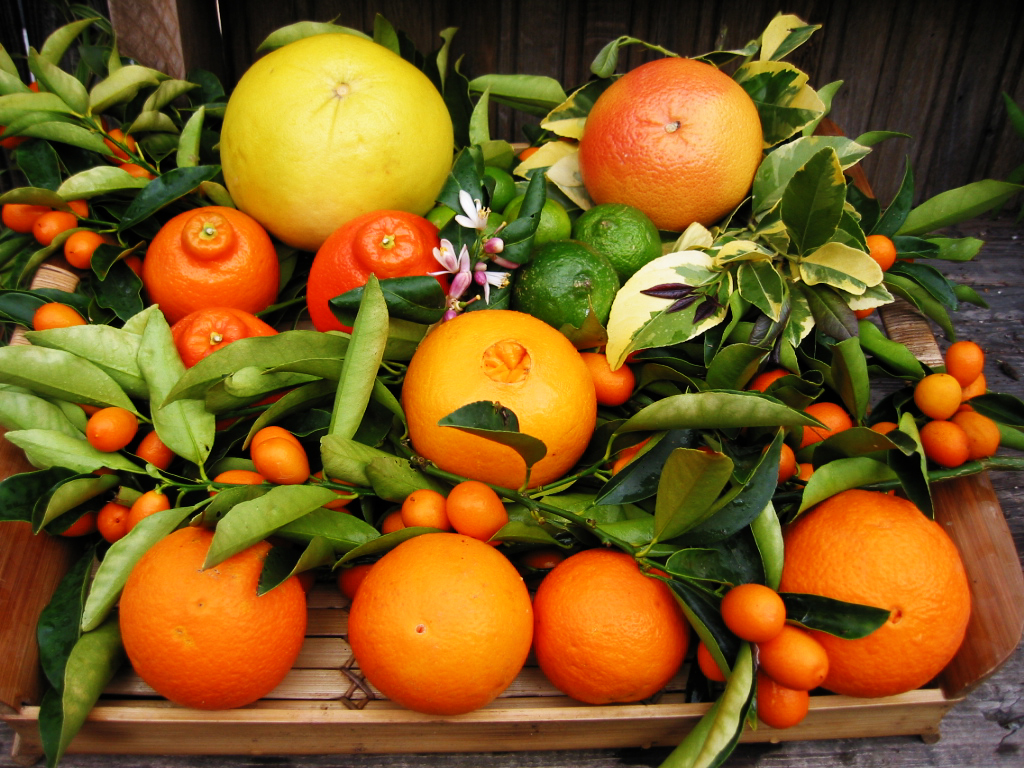
Grown for the foliage: leaves
of the Kieffer lime are cut into fine slivers and
added to Thai and Cambodian recipes. If you see ' citrus leaves ' in a Thai
recipe, this is what it means. The fruit is a strange, warty green thing, but
the peel imparts a special flavor to curries.
Learn a little about frost protection, take some care at planting time, water deeply and set up a simple feeding schedule. Citrus can be a stress-free part of your family orchard, or an attractive addition to the landscape.
© 2008 Don Shor, Redwood Barn Nursery, Inc., 1607 Fifth Street, Davis, Ca 95616
www.redwoodbarn.com
Feel free to copy and distribute this article with attribution to this author.
Click here for Don's other Davis Enterprise articles
