The Other Roses
From the Davis Enterprise, Feb. 22, 2007
Every so often someone asks me 'what are your favorite roses?'
I can try to
answer that at various levels: sentimental favorites (Nastarana, Chrysler
Imperial), favorite new varieties (Marilyn Monroe, Sunset Celebration), for
cutting (Crimson Beauty, Olympiad), for photographing (species or semi-double
roses).
But having grown
hundreds of roses and sold and supervised many more, I've come to admire roses
that have endurance, disease resistance, and abundance of bloom. Frankly, I
don't feel like fussing with roses, hardly ever spray for anything, and mostly
enjoy them while walking through the garden. Fragrance, of course, is
important, but I can respect a lightly scented rose if it tolerates blazing heat
or blooms like crazy. If a rose is weak, disease-prone, or wimpy, I just 'prune
it with a shovel' and plant a better variety.
My fondness for
easy-care roses leads me naturally to some of the lesser-known groups of
hybrids. In recent years the 20th century queen of roses, the Hybrid
Tea, has been challenged by several breeds: Floribundas, Grandifloras, David
Austin's English roses, shrub and landscape roses (including the incredibly
popular ground cover roses in the Flower Carpet series), and even modern
climbers.
Not that there's
anything wrong with Hybrid Teas: for long stemmed cutting roses, they still
reign supreme. But the cluster-blooming habit of the other types makes them
more attractive in the landscape. So in designing a rose garden, I suggest
grouping your cutting roses and putting some of these 'other' roses behind or
in front of them to get the best of both worlds.
What are all these
categories of roses?! Here's a capsule history of the rose world. Until the 19th
century cultivated roses in Europe and America rarely rebloomed after the
spring, and most were pink, red, or white. Yellow roses were unknown to
Europeans until the introduction of rose species from Persia and Asia. A couple
of reblooming roses were also introduced in the late 18th and early
19th centuries and became incredibly popular. They became important
parents of modern roses, as a whole class of roses called Hybrid Perpetuals
dominated the nursery trade.
Then in the 19th
century the 'tea' rose – a delicate, scented rose with classic
overlapping (not bunched or 'quartered') petals was introduced from Asia, and
its elegance and form made it highly prized even though it was tender and fussy
to grow. Crossing it with the Hybrid Perpetuals led to the Hybrid Tea roses
(typical Hybrid Tea shown above), which have been the highest-selling group of
roses throughout the 20th century. If a novice asks me for a rose
bush, I assume they mean a Hybrid Tea.
But all the while
breeders were crossing these and other roses to create better garden plants.
Those old Hybrid Perpetuals sprawled everywhere, taking 5 – 6' of space
or more per plant. The Victorian-era trend of planting roses in mass groups in
public parks made some of the shorter, more free-blooming types popular, Polyantha
and Floribunda roses in particular. With the advent of modern garden chemicals,
the disease susceptibility of many Hybrid Teas seemed irrelevant; I remember my
grandfather's elaborate spray schedule in quest of the perfect rose for the
vase on the breakfast table.
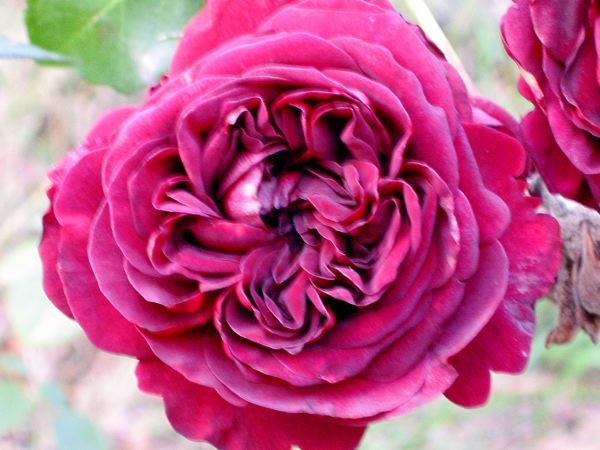
Some rose lovers actively preserve the old
roses. Heritage or heirloom roses have a special appeal, as many have extra
fragrance and unique flower form. Modern roses typically have 20 – 50
petals; those 19th century ones may have over 100 petals, all
stuffed together, crinkled, 'quartered'—the roses of Empress Josephine's
garden, made famous by the painter Redout', are Hybrid Perpetuals. Cemeteries
happen to be great places to see the favorite roses people have planted and
tended on graves over the years, and avid rose fanciers often seek them out. An
excellent local collection of heirloom roses can be seen at the Old City
Cemetery at 1000 Broadway in Sacramento (www.oldcitycemetery.com).
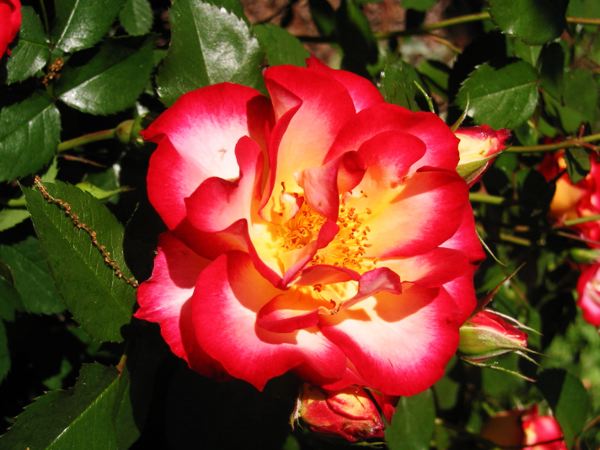
Not content to
leave these roses to posterity, the English breeder David Austin started
crossing them with modern roses. 'The Prince' is shown at right. His goals were to obtain more compact
growth habit with the old-fashioned look and fragrance of heirloom roses. His
roses tend to get big! Some sold as shrubs in England act more like climbers in
our milder California climate. Now commonly called English roses, these give a
classic look to a wide perennial border.
Other breeders
have followed suit. Meilland of France introduced the Romantica roses, one of the best of which is a climbing variety called Eden. It looks like something from the 1800's --
but was introduced in 1992.
These other groups
broaden the opportunities for fitting roses in niches of the landscape beyond
the traditional grid-planting typically used for cutting roses.
Need a hedge? Simplicity, a tall floribunda
rose, was introduced as a 'hedge' rose by Jackson & Perkins in the 1970's.
Any number of other floribundas can be planted on 2 – 3' spacing and be
pruned with hedge shears: Iceberg, Betty Boop (photo, right), and Scentimental
are good examples.
Want to cover a wall? Modern climbing roses
bloom from spring through fall: 4th of July is an outstanding,
disease-free variety with gaudy red-and-white striped flowers.
Want cut flowers in less than ideal
sunshine? Most roses need at least 4 – 6 hours of direct sun, or they
give fewer flowers and are more prone to mildew. But floribundas and
grandifloras generally have better disease resistance, and have stems adequate
for cutting. Sunsprite is an excellent yellow, Iceberg is pure white (see the
planting on the south side of Hibbert Lumber at 5th and G Streets).
So my favorite
roses are mostly ones that are easy to grow. Yours might be the one grandmother
grew, or varieties that cut well. There is a rose for nearly every situation in
your landscape and every gardening style. Heirloom, retro or contemporary,
coddled or carefree, the world of roses is yours to explore.
© 2008 Don Shor, Redwood Barn Nursery, Inc., 1607 Fifth Street, Davis, Ca 95616
www.redwoodbarn.com
Feel free to copy and distribute this article with attribution to this author.
Click here for Don's other Davis Enterprise articles
