September means planning for winter fragrance!
Written for the Davis Enterprise, August 23, 2001
September isn't really fall, is it?
Not here in the valley! It can be hot and dusty, which makes it hard for gardeners to look forward to the next season. But just as we plan in spring for our summer gardens, NOW is the time to plan and plant for your winter garden!
Good gardeners are always looking ahead to the next two seasons.
You're picking peppers and thinking about peas! The powerful scent of a summer gardenia reminds you that it's time to think about winter fragrance. For generations of gardeners, winter fragrance has meant Sweet peas (Lathyrus) and Stock (Matthiola). If you're frugal and like to plant from seed, September is when you plant both of these. (You can also do a planting of Sweet peas in February and hope that we don't get hot earlier than usual).
When I was a young teen, working around the neighborhood, I worked for one afternoon for a plant breeder who also happened to be an excellent and rather particular gardener. He hired me to dig a trench a foot deep, setting aside the soil; then I dug compost and manure into the next foot of soil, and planted sweet pea seeds in the bottom of the trench. I blended compost and manure with the first soil and set it aside, as he planned to layer it in over the plants as the vines grew. Sure seemed like a lot of work (which, of course, is why he was paying me to do it!).
Years later this technique became popular with organic gardeners in areas of poor soils and was called double digging. I call it aerobic gardening. I thought I must have done it right, because years later he complimented me on the quality of the sweet peas that year. But I now know that a lot of it was luck-- mild weather when the vines are flowering--and some of it was knowing which varieties to plant. Not to mention knowing how to tell a 14-year-old boy how to do a task correctly! I'm still working on this last concept....
Sweet peas like a mild climate, and especially dislike hot weather.
We plant them here so they're established enough to get through the winter and bloom before hot weather hits. Our winters are rarely cold enough to damage the plants, although they were killed or severely damaged in the severe freezes of 1990 and 1998. Sweet peas need full sun in the winter--watch the sun pattern as it shifts to the south to make sure they won't be in the shade in February and March. They prefer soil that has been amended (see above!) so it drains well in the winter. There are dwarf and trailing varieties that can be grown in pots.
The names of the different types of sweet peas can be a little confusing.
Older varieties are usually called "heirlooms." Modern varieties are called Spring-flowering and Summer-flowering, but none of them really flower in the summer here. These types start blooming when daylength is increasing in mid-Spring, and flower from mid-April through May until temperatures reach the mid-90's. Early-flowering varieties will bloom earlier in the winter if you plant them early enough (i.e., NOW!), but are less heat-tolerant.
The older varieties are remarkable for their fragrance and have become available again from specialty seed suppliers. W. Atlee Burpee Co. , the venerable seed company now owned by George Ball, is offering an excellent selection which is now available at Redwood Barn!
I said that none of the regular sweet peas bloom in the summer here, but folks driving through Gold Country and other parts of Northern California have probably noticed the two-toned perennial Sweet pea (Lathyrus latifolius) that has naturalized in those areas. This one is different: it blooms in the summer and tolerates aridity, but isn't especially fragrant.
Stock is like deer: the name is singular and plural at the same time. This is one of our best winter annuals.
I have no idea what the common name comes from, and a quick search of reference books and on the Internet didn't elucidate. The Sunset Western Garden Book describes some as being "branching" (multiple shoots from the base) and others as being "unbranched." Our experience is that early planting (i.e., NOW!) will give you plants that branch from the base, and late planting will give a single spike of flowers. The flowers have a great sweet/spicy fragrance. Like Sweet peas, you don't just stick these in the ground in heavy soil areas: turn compost into the whole area before you plant.
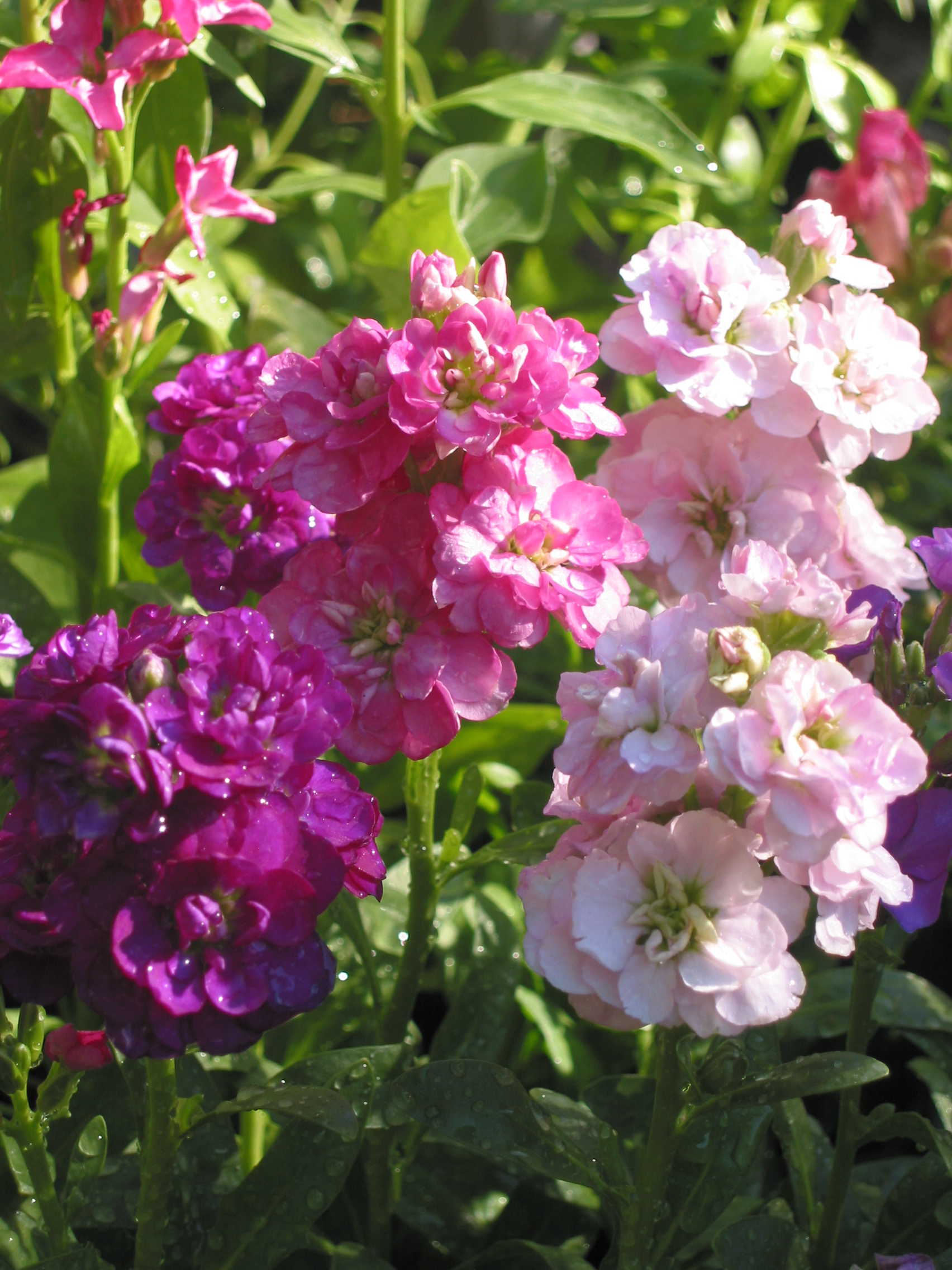 The dwarf, double-flowered stock available from most garden centers
I have an old memory of Stock...another good gardener in that same neighborhood where I grew up: a wonderful woman who let me plant whatever I wanted in her yard, as long as she could cut or smell the flowers. She planted intensely fragrant Stock just under the window where the breeze came in. Years later I smelled the Stock we sell as bedding plants and got a hint of that sweet and spicy fragrance, but I realized that she had planted a different species (M. longipetala bicornis) known as the Evening-scented stock. Unfortunately, this stock is not common in the trade.
Nevertheless, the Stock that you plant from seed or six-packs will have some of that same special scent. Plant it in full winter sun. The more dwarf varieties aren't as fragrant, but can be crowded into small pots for winter color. Although we sell it as a winter annual, many gardeners report stock living through the summer and reblooming, and it occasionally naturalizes by reseeding, gradually reverting to taller, single-flowered types.
There are other seeds to plant in September.
Snapdragons, Calendulas, Pansies and Violas are popular winter and spring-blooming annuals that can be grown from seed or transplanted from seedling packs.
Wildflower seeds are planted now for late winter and spring bloom--California poppies are the best known, but Lupines, Tidytips, and many others grow and naturalize well here. You can't just fling these seeds onto hard, dry soil: loosen it first by tilling or scratching the surface. Cover the seed with a fine layer of compost, and water daily for a few weeks until winter rains begin.
Many perennials can be grown from seed or transplants now for blooms next year. And vegetable growers are already planning their winter gardens, planting broccoli, cauliflower, cabbage, peas, carrots, beets, and more.
Save money and spice up your winter garden by planting now from seed!
© 2008 Don Shor, Redwood Barn Nursery, Inc., 1607 Fifth Street, Davis, Ca 95616
www.redwoodbarn.com
Feel free to copy and distribute this article with attribution to this author.
Click here for Don's other Davis Enterprise articles
