A Touch of the Tropics!
Written for the Davis Enterprise, June 27, 2002
Bright colors, bold textures, glossy foliage--the look of the tropics. Vigorous summer growth and perhaps a fruity or spicy fragrance reminiscent of warm Pacific breezes.That's why gardeners love the plants we call subtropicals, and stretch the boundaries of hardiness to grow these special plants. They thrive in and remind us of Hawaii, San Diego, and other regions where weather is balmy and it never freezes. They love our summers, thriving in heat and sun, but hate our winters and may require special protection. Citrus trees are the best-known subtropicals, but there are many others prized for their foliage, flowers, or fragrance.
Subtropicals can be grouped by cold-hardiness, as this determines where you will grow them and what you'll need to do each winter. A good rule of thumb is that if the Sunset Western Garden Book lists a plant for zones 15 - 19 (but not our zone14, or nearby zones 8 - 9), we can grow it here in a warm microclimate or with winter protection. If it is listed for zones 21 - 24 it is unlikely to survive outdoors here. Subtropicals are most readily available in the summer, as they sulk in the cool spring weather and don't become saleable until nights are consistently warm.
If it is a special plant, put it in a pot so you can move it to a sheltered location in the winter--or even bring it inside. Various measures on frosty nights can reduce cold damage. Plants in the ground can be protected by a chain of Christmas lights (the larger bulb types, not the twinkle lights) or a clip-on shop light with a 40W bulb, a gentle covering with a "seedling blanket", a spray with an anti-transpirant, and a good soaking before a cold night. Each of these measures can give a couple of degrees of protection and can make enough difference to save the plant's life.
1. Always tender.
Truly tropical plants suffer below 50F and must be brought indoors by mid-October, so they are basically houseplants. Examples include most orchids (Cymbidiums are a hardy exception), fragrant Plumeria (also called Frangipani), Arabian or "true" jasmine (Jasminum sambac, used for jasmine tea and called pikake in Hawaii) and Madagascar jasmine (Stephanotis floribunda), and the spectacular pink-flowered Mandevillas. These last are being widely sold in "big box" retailers throughout Northern California (often labeled by the old name Dipladenia). All of these plants will simply die if left outside in a normal winter here, even in a frost-protected location. Bring them indoors when the nights dip below 50, preferably into the brightest south or east-facing window in your house. Bird of paradise (Strelitzia reginae) will grow and bloom in a protected patio or courtyard and will recover, albeit slowly, from a hard freeze.
Most house plants that are grown for foliage, such as Philodendron, Pothos, and Schefflera, are also tropicals. These can spend the summer outdoors but should be inside by Halloween. Remember to check for pests--aphids on the leaves, or a nest of ants in the soil, would be an unpleasant surprise! A quick spray with insecticidal soap is a good preventative.
2. Need protected location, but will recover.
Many subtropicals will be damaged by frost but are killed only by severe freezes. Bougainvillea and tropical Hibiscus bloom freely in the summer and into the fall, but the tops will be killed 50 – 75% or more in the winter. Wait until new growth begins in April before you cut back the frozen parts. 'Barbara Karst' and 'San Diego Red' are the most vigorous Bougainvillea, so they recover quickly and are highly recommended. Plant on a south-facing wall for winter sun, under an overhang to trap heat. Bougainvillea bloom best if kept dry and rootbound, so they are great in containers. Prune lightly, if at all, during the summer as the blooms are at the end of the new growth--every cut you make reduces the bloom. There are species of Hibiscus that are perfectly hardy here: H. moscheutos and H. syriacus give the showy flowers without needing protection.
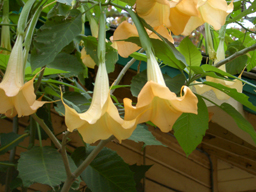
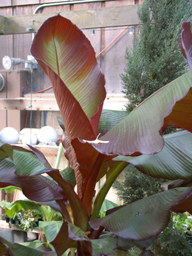
Angel's Trumpet (Brugmansia; formerly Datura) is a special plant with stunning, huge trumpet-shaped flowers in white, yellow, or light pink. If you have the space--it is big and dramatic--it is worth growing. The nighttime fragrance is intoxicating (almost literally: the plant contains some narcotic properties BUT IS ALSO POISONOUS). Shelter it from wind, as the large, tropical looking leaves are easily tattered. Winter damage ranges from light leaf burn to 50% kill, but these have recovered even from the hard freezes of 1990 and 1998. For a tropical look you can't beat bananas (Musa and Ensete species). The large leaves are also vulnerable to the wind. Most are tender, but some species are root-hardy and will resprout even after hard freezes.
3. Usually hardy, but expect top damage.
The vines that bloom gloriously all summer long are mostly subtropicals; hardier vines tend to have a shorter, more intense bloom season concentrated in milder weather. Passion flower vines (Passiflora), Blood-red trumpet vine, Lavender star-flower (Grewia caffra), Cape honeysuckle (Tecoma capensis), Bower vine (Pandorea)--all grow fast and produce showy flowers over a long season. These recover quickly from winter damage, but their unsightly winter appearance means they shouldn't be planted in a year-'round focal point.
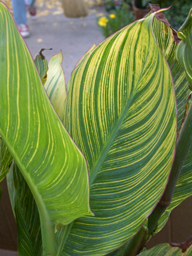
Canna lilies give the look of the tropics without any fuss. They produce big, glossy leaves, which grow quickly in the summer to 3 - 6' tall, providing a tropical look. Some have red or striped leaves that provide striking contrast. Cannas are a little coarse looking up close, so put them in the back of the perennial border or around a pool or water feature. They can tolerate the hottest sun or moderate shade, and they spread steadily by rhizomes. They can take regular garden watering, or can even stand in water or grow in soggy soil. The dramatic flowers are yellow, orange, or red, and are often spotted or bicolor. Freezing weather turns the leaves to black and the succulent stems to mush. Whack them to the ground as soon as they look ugly; this is one subtropical where you don't have to wait until spring to cut it back. A machete is a particularly suitable pruning tool for Cannas, and the leaves make a great addition to the compost pile.
Some of our showy ground covers are subtropicals, including the familiar Lantana and Verbena. Again, these provide showy flowers in extremely hot environments and tolerate drought. The leaves will blacken in freezing weather and the plants may even be killed to the ground. Cut off all the dead wood as soon as new growth begins in spring. There are shrubby Lantanas in bright oranges, reds, and yellows, and ground-covering forms in lavender and white. Verbenas come in electric shades of purple, lavender, rose, red, and pure bright white. Both are excellent plants for quick color in new landscapes.
With the right plant in the right location, and a little special care in the winter, you can bring a touch of the tropics to the Sacramento Valley in the summer!
See also Passifloras
© 2008 Don Shor, Redwood Barn Nursery, Inc., 1607 Fifth Street, Davis, Ca 95616
www.redwoodbarn.com
Feel free to copy and distribute this article with attribution to this author.
Click here for Don's other Davis Enterprise articles
